


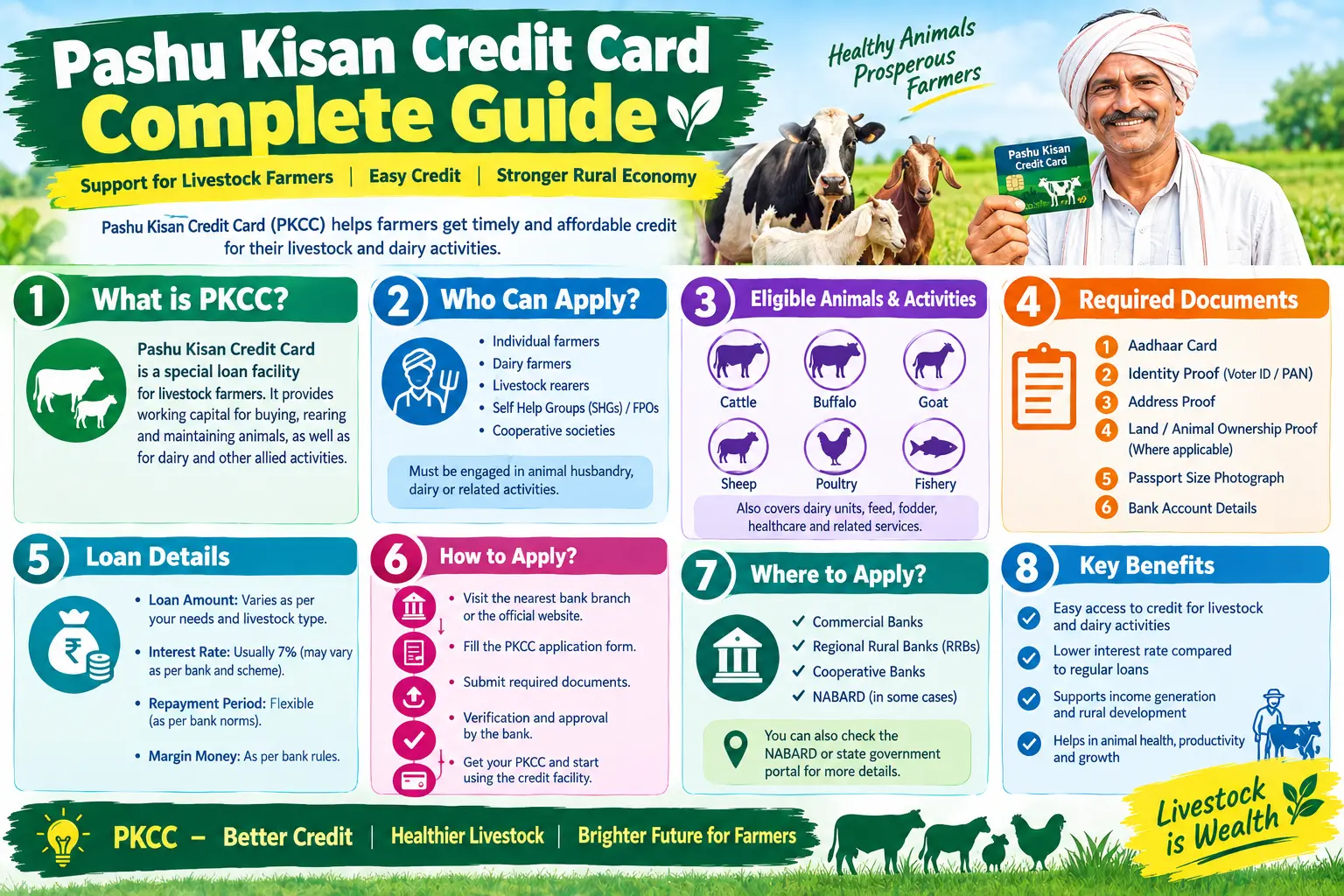
A dairy farmer in Gujarat needs ₹40,000 for cattle feed before the monsoon. A poultry rearer in Andhra Pradesh wants to add 200 birds to her shed but has no land to pledge. Both are exactly the kind of borrower the pashu kisan credit card was designed for — and both would struggle to get that money from a private lender at anything close to a fair rate. This guide covers who qualifies, what the card actually offers, which documents banks ask for, and how the application typically moves from form to sanction. Read it before you visit your branch, and you will save yourself at least one wasted trip.
What Is the Pashu Kisan Credit Card?
The Pashu Kisan Credit Card (PKCC) is the animal husbandry arm of the kisan credit card scheme. The original KCC was built for crop farmers; the Reserve Bank of India later extended the same facility to livestock and fisheries, recognising that working capital needs do not stop at the field boundary. Instead of funding seeds and fertiliser, a PKCC funds feed, veterinary care, animal purchase, shed repairs, pond maintenance, and fishing equipment.
Haryana ran an early version of the scheme for cattle farmers, and states such as Andhra Pradesh have since rolled out their own variants. The mechanics differ slightly from state to state, but the premise is the same: institutional credit at crop-farmer rates, so that livestock owners are not pushed toward moneylenders charging 30–50% a year. Under the broader kisan credit card yojana, animal husbandry is treated as an agricultural activity in its own right — not a side business.
Discover More About:👇
KCC – Kisan Credit Card Full Guide 2026
KCC Loan Kaise Milega – Interest Rate & Documents
Who Can Apply for This Scheme?
Eligibility is broader than most farmers assume. If your income comes from animals rather than crops, you are likely covered under one of these categories.
Dairy Farmers
Anyone owning cows, buffaloes, or other milch animals. The credit covers feed, fodder, medicines, artificial insemination, and animal purchase.
Poultry and Small Ruminant Rearers
Poultry, goat, sheep, and rabbit farmers qualify — including tenant farmers who own, lease, or rent their sheds. Joint liability groups and self-help groups can apply as a unit, which matters for farmers who have no individual land title.
Fisheries – Inland and Marine
Inland fish farmers can borrow for pond maintenance, seed, and feed. Marine fishermen typically need a registered vessel and valid fishing licences, since the bank will want to verify the asset being financed.
Self-Help Groups and Women’s Groups
Women’s SHGs have been among the most active users of this scheme, often pooling the credit to set up small dairy units. Group applications are usually processed against the group’s track record rather than individual collateral.
Features and Benefits of the Pashu Kisan Credit Card
Loan Limits
The limit is generally calculated from the number and type of animals you own. Commonly, up to ₹1.60 lakh is available without collateral or property papers. Above that, banks may ask for property documents as security. Some banks advertise limits up to ₹3 lakh under general KCC norms, but this varies — treat your bank’s figure as the only one that counts.
Interest Rate and Subvention
Banks typically charge around 7% on these loans. Borrowers who repay on schedule may receive a 3% interest subvention, bringing the effective rate to roughly 4%. That subvention is conditional, not automatic — miss an instalment and you can lose it for the year.
Collateral-Free Credit
The ₹1.60 lakh collateral-free ceiling is the single most useful feature for small and marginal farmers, who often have animals but no land to pledge. If your requirement is modest, you can borrow without touching your property papers at all.
Flexible Repayment
Repayment is generally structured around livestock income cycles rather than a rigid monthly EMI, so a dairy farmer paid fortnightly by a milk cooperative is not forced into a mismatch between cash inflow and instalment dates.
Documents Required for Pashu Kisan Credit Card
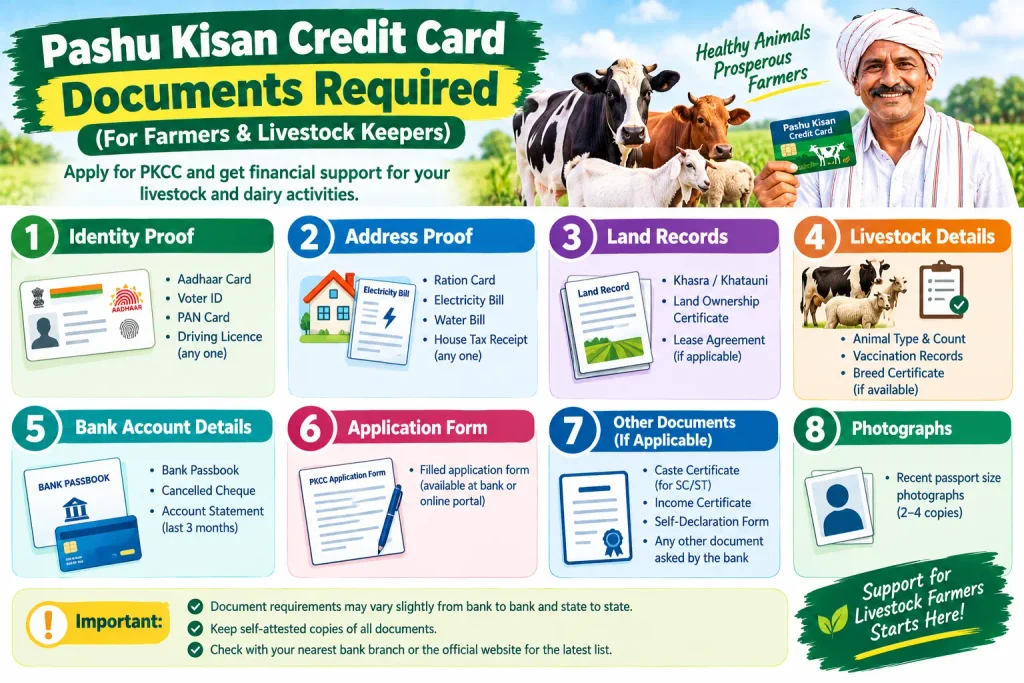
Banks commonly ask for the following. The exact list varies by bank and state, so confirm it with your branch before you queue up.
- Identity proof: Aadhaar, PAN, or Voter ID
- Address proof: Aadhaar, Voter ID, or a utility bill in your name
- Active bank account details: The card is linked to an account, so a dormant account will cause problems
- Passport-size photographs: Recent, not the ones from your last licence application
- Livestock ownership proof: Records showing the animals or fisheries assets you own
- Animal health certificate: Frequently required, and in some cases proof of cattle insurance
- Land documents: Only where applicable, usually for higher loan amounts
- Completed application form: The bank’s own PKCC or Animal Husbandry KCC form
How to Apply for Pashu Kisan Credit Card
The process runs through a bank branch in most cases. Here is what actually happens, step by step.
Step 1: Visit Your Nearest Bank Branch
Walk into a government or commercial bank branch and ask specifically for the Pashu Kisan Credit Card or Animal Husbandry KCC form. Not every counter staff member will recognise the acronym, so say “KCC for animal husbandry” if you get a blank look.
Step 2: Fill Out the Application Form
Enter your personal details, livestock holdings, and bank information accurately. A mismatch between the animals you declare and the certificate you submit is one of the most common reasons an application stalls at the verification stage.
Step 3: Attach the Required Documents
Photocopies of identity and address proof, bank details, photographs, livestock ownership proof, and the animal health certificate. Carry originals for verification — banks usually return them on the spot, but you will need them.
Step 4: Submit the Application
Hand in the form and documents at the branch. In some locations, a Common Service Centre (CSC) can help you submit the application if you cannot reach the branch during working hours. Get an acknowledgement or receipt for your submission; without it, follow-up becomes guesswork.
Step 5: Verification and Issuance
The bank verifies your documents and may conduct a field visit to confirm your livestock. Once cleared, the card is issued and works much like a debit card — you withdraw funds as needed for approved purposes rather than receiving a lump sum.
Two pitfalls worth knowing. First, if your animal health certificate is older than the bank’s acceptable window or issued by a veterinarian the bank does not recognise, you will be sent back to get a fresh one. Second, if you apply as part of an SHG, the group’s repayment record is scrutinised as closely as your own — one defaulting member can hold up everyone’s application.
Discover More About:👇
KCC Online Apply & KCC Rin Portal
Common Mistakes to Avoid
- Submitting incomplete documents. Missing or illegible photocopies are the most frequent cause of delay. Run through the list twice before submitting.
- Skipping the animal health certificate. Many applicants assume it is optional because the form does not highlight it. It usually is not.
- Assuming terms are uniform across states. Loan ceilings, subvention rules, and even the form itself differ between states and banks. What your neighbour got in another district may not apply to you.
- Not reading the subvention conditions. The 3% benefit is tied to timely repayment. Ask the branch officer to explain the repayment schedule in writing before you accept the loan.
Frequently Asked Questions (FAQs)
What is the maximum loan amount under Pashu Kisan Credit Card?
It varies by state and bank. Commonly, up to ₹1.60 lakh is available without collateral, with higher amounts possible against property security. Some banks cite limits up to ₹3 lakh under general KCC norms. Confirm your bank’s current ceiling directly.
Is collateral required for Pashu Kisan Credit Card?
Typically not, for loans up to ₹1.60 lakh. Above that threshold, banks may ask for property papers.
What interest rate applies?
Banks generally charge around 7%, with a 3% subvention for borrowers who repay on time — bringing the effective rate to roughly 4%. Subvention rules can change, so verify at the branch.
Can women apply for Pashu Kisan Credit Card?
Yes. Women, particularly through self-help groups, are eligible and have been among the scheme’s most active beneficiaries.
How long does it take to get the card?
Timelines vary by bank and location. Once verification and any field visit are complete, issuance may take a few weeks. There is no fixed national timeline, so ask your branch for an estimate.
Where can I apply?
At your nearest government or commercial bank branch. In some areas, CSC centres assist with submissions.
A Final Word
Before you fill anything in, make one phone call to your intended branch and ask two questions: what is your current collateral-free ceiling, and what exactly do you need as livestock proof. Those two answers will tell you more about your chances than any general guide — including this one — because the scheme is administered at the state and bank level, and the fine print moves. If the branch cannot give you a clear answer, try a different bank before assuming you are ineligible.
