


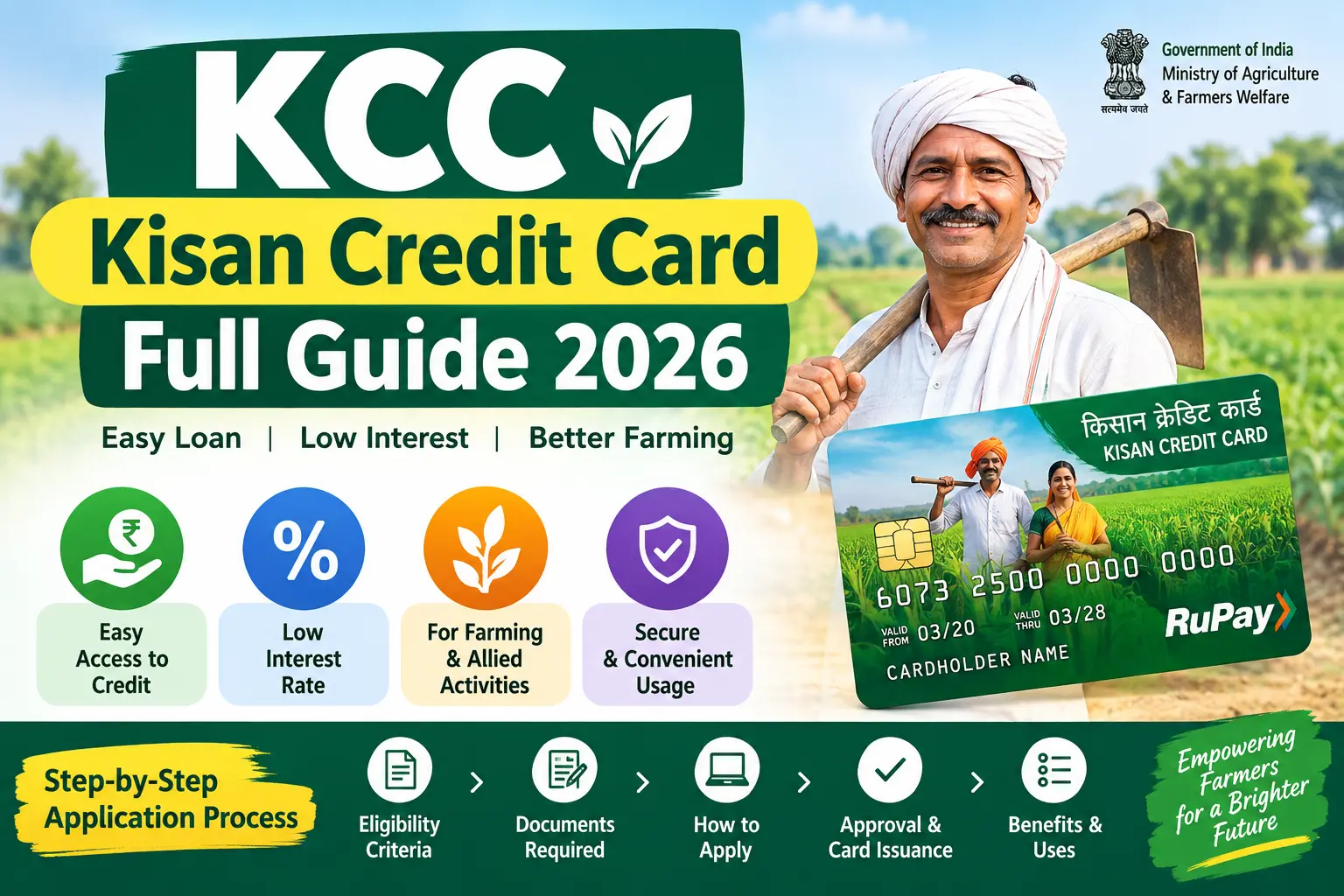
A farmer in need of ₹50,000 for seeds and fertiliser before sowing season shouldn’t have to borrow from a moneylender at 30% interest. That is precisely the gap the Kisan Credit Card (KCC) was designed to close. Yet thousands of eligible farmers still don’t have one, often because the application process seems unclear or because they assume land ownership is mandatory. This guide walks through what KCC offers in 2026, who qualifies, how the application actually works, and the small mistakes that cause applications to stall.
What the Kisan Credit Card Actually Is
The KCC full form is Kisan Credit Card, and it has been part of India’s agricultural credit system since 1998. The name is slightly misleading. It is not a credit card in the shopping sense; it is a sanctioned credit limit from a bank that you can draw from as needed, repay, and draw again within the same limit.
That limit is typically fixed for five years, with an annual review. In most banks, the card is now issued as an ATM-enabled RuPay debit card, so you can withdraw funds from an ATM rather than visiting the branch each time.
The scheme’s scope has widened considerably. What started as a crop loan instrument now extends to dairy, poultry, fisheries, and beekeeping. Government data cited in 2026 places the number of operational KCCs at over 7.7 crore.
Discover More About:👇
KCC Loan Kaise Milega – Interest Rate & Documents
KCC Online Apply & KCC Rin Portal
Who Qualifies
Eligibility is broader than many farmers assume. The following categories are generally covered:
- Owner-cultivators — individual farmers and joint borrowers.
- Tenant farmers, oral lessees, and sharecroppers — a deliberately inclusive category, since these groups often struggle to access formal credit.
- Self Help Groups (SHGs) and Joint Liability Groups (JLGs), including groups of tenant farmers and sharecroppers.
- Fishers and fish farmers, brought under KCC in 2018–19.
- Animal husbandry and dairy farmers, who can use KCC for working capital.
There is no strict upper age limit in the core guidelines, though individual banks may apply their own norms. The practical requirement is genuine engagement in farming or an allied activity.
Limits and Interest Rates in 2026
The numbers below reflect recent government and RBI communications. Rates and caps are revised periodically, so confirm current figures with your bank before applying.
Crop loan limit under MISS: Short-term crop loans under the Modified Interest Subvention Scheme now carry a limit of ₹5 lakh.
Allied activities: Fisheries, animal husbandry, and similar activities also have a limit of ₹5 lakh.
Collateral-free limit: Short-term agricultural loans, including allied activities, are collateral-free up to ₹2 lakh per borrower, effective 1 January 2025. Below this threshold, you generally do not need to pledge assets.
Interest rate: Short-term agri-loans are offered at 7% per annum. Borrowers who repay on time receive a 3% prompt repayment incentive, bringing the effective rate to 4% per annum.
Two conditions govern these benefits. Interest subvention applies within prescribed caps, and the crop loan component typically takes priority. The 4% effective rate is contingent on prompt repayment; miss the deadline and the 3% incentive is withdrawn.
How to Apply
Applications can be made online through your bank’s website or offline at a branch. Some banks also accept applications through Common Service Centres (CSCs) in rural areas. Steps vary by bank, but the general flow is consistent.
Online
- Go to the official website of the bank you want to borrow from — a public sector bank, regional rural bank, cooperative bank, or small finance bank.
- Find the KCC or agricultural loan section, usually under farmer services.
- Fill in the application with your personal details, landholding information, and the farming or allied activity you are engaged in.
- Submit the form and save the application reference number.
- Wait for the bank to contact you, typically within a few working days, to verify details.
Pitfalls to watch for: Bank portals sometimes time out during long forms, so keep your land records and Aadhaar number handy before you start. If you are applying through a CSC, confirm that the operator is using your correct mobile number — a mismatch here is a common reason applicants never receive follow-up calls.
Offline
- Visit the nearest branch of your bank or any bank implementing the KCC scheme.
- Ask the concerned official for the KCC application form.
- Fill it in completely and attach the documents listed below.
- Submit the form and collect an acknowledgment or reference number.
Documents Typically Required
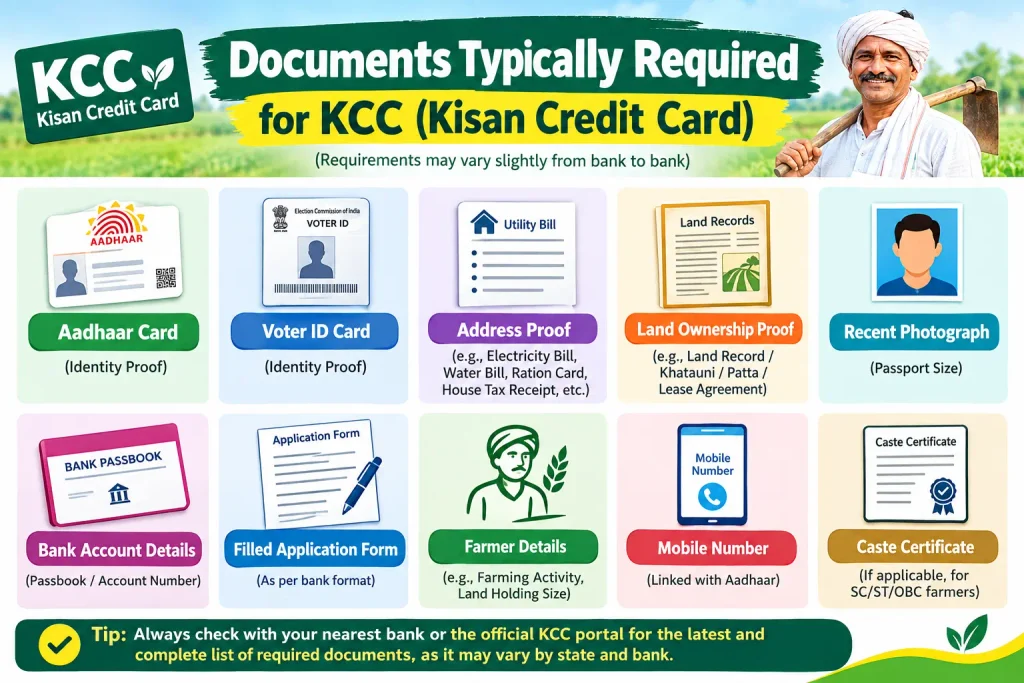
The exact list varies by bank and borrower type, but the following are commonly accepted:
- Identity proof: Aadhaar card, Voter ID, PAN card, driving licence, or passport.
- Address proof: Aadhaar card, utility bill, or another document accepted by the bank.
- Land records: Ownership documents, tenancy agreements, or sharecropping arrangements. For tenant farmers and sharecroppers, banks may accept alternative documentation as per internal norms.
- Passport-size photographs.
- Bank account details, if you already hold an account with the lending bank.
Aadhaar seeding is mandatory for interest subvention benefits under MISS, though it is not strictly mandatory for the KCC loan itself at some banks. Linking Aadhaar to your bank account generally speeds up the process and ensures you receive the subvention without delay.
For remote applications, Aadhaar paperless offline e-KYC can help. You can download your KYC XML from the official UIDAI portal or the mAadhaar app — the file is digitally signed by UIDAI and can be shared with the bank using a share phrase, removing the need for physical photocopies.
Discover More About:👇
Pashu Kisan Credit Card – Complete Guide
Common Mistakes That Delay Applications
Aadhaar not linked to the bank account. Without seeding and authentication, you may miss the 4% effective rate entirely.
Incomplete land records. Tenant farmers and sharecroppers often have different documentation requirements than owner-cultivators. Ask the bank what it will accept before submitting.
Assuming a uniform limit. The credit limit depends on the scale of finance for your crop, your landholding, and other factors. Marginal farmers may have a differently structured limit.
Ignoring the annual review. The limit is reviewed each year and may be revised based on cropping pattern or scale of finance changes. Dormant accounts may see adjustments.
Late repayment. The 4% rate depends on prompt repayment. Delay costs you the 3% incentive.
Frequently Asked Questions
What is the full form of KCC?
Kisan Credit Card. It provides farmers with affordable, timely credit for agriculture and allied activities.
Can tenant farmers and sharecroppers apply?
Yes. Tenant farmers, oral lessees, and sharecroppers are explicitly covered. Banks may ask for specific documentation to verify cultivation rights, so check with your branch first.
Is there a fee to apply?
The scheme itself does not typically carry a separate application fee, but banks may charge nominal processing fees under their own policies. Confirm with your bank.
What is the maximum KCC limit in 2026?
Short-term crop loans under MISS are capped at ₹5 lakh. Allied activities such as fisheries and animal husbandry also carry a ₹5 lakh limit. The collateral-free threshold is ₹2 lakh per borrower.
Can I get a KCC without land ownership documents?
Owner-cultivators typically need land records. Tenant farmers and sharecroppers are eligible, and banks may accept alternative documentation to establish cultivation rights. Requirements vary by bank and region.
How is the KCC limit calculated?
It is generally based on the scale of finance for the crop, the area cultivated, and components for post-harvest expenses, farm asset maintenance, and consumption needs. RBI guidelines prescribe the methodology; individual banks implement it.
Closing Thoughts
The gap between eligibility and actually holding a KCC often comes down to paperwork — a missing Aadhaar link, an incomplete tenancy record, a form submitted without a reference number. If your first application is rejected or stalls, ask the branch specifically which document was deficient rather than reapplying with the same set. And since interest subvention caps, collateral-free thresholds, and prompt repayment rules are revised periodically, verify the current terms with your bank or on the official UIDAI portal (uidai.gov.in) for Aadhaar-related matters before you finalise your application.

3 Comments
Pingback: KCC Loan Kaise Milega – Interest Rate & Documents
Pingback: KCC Online Apply & KCC Rin Portal
Pingback: Pashu Kisan Credit Card – Complete Guide