


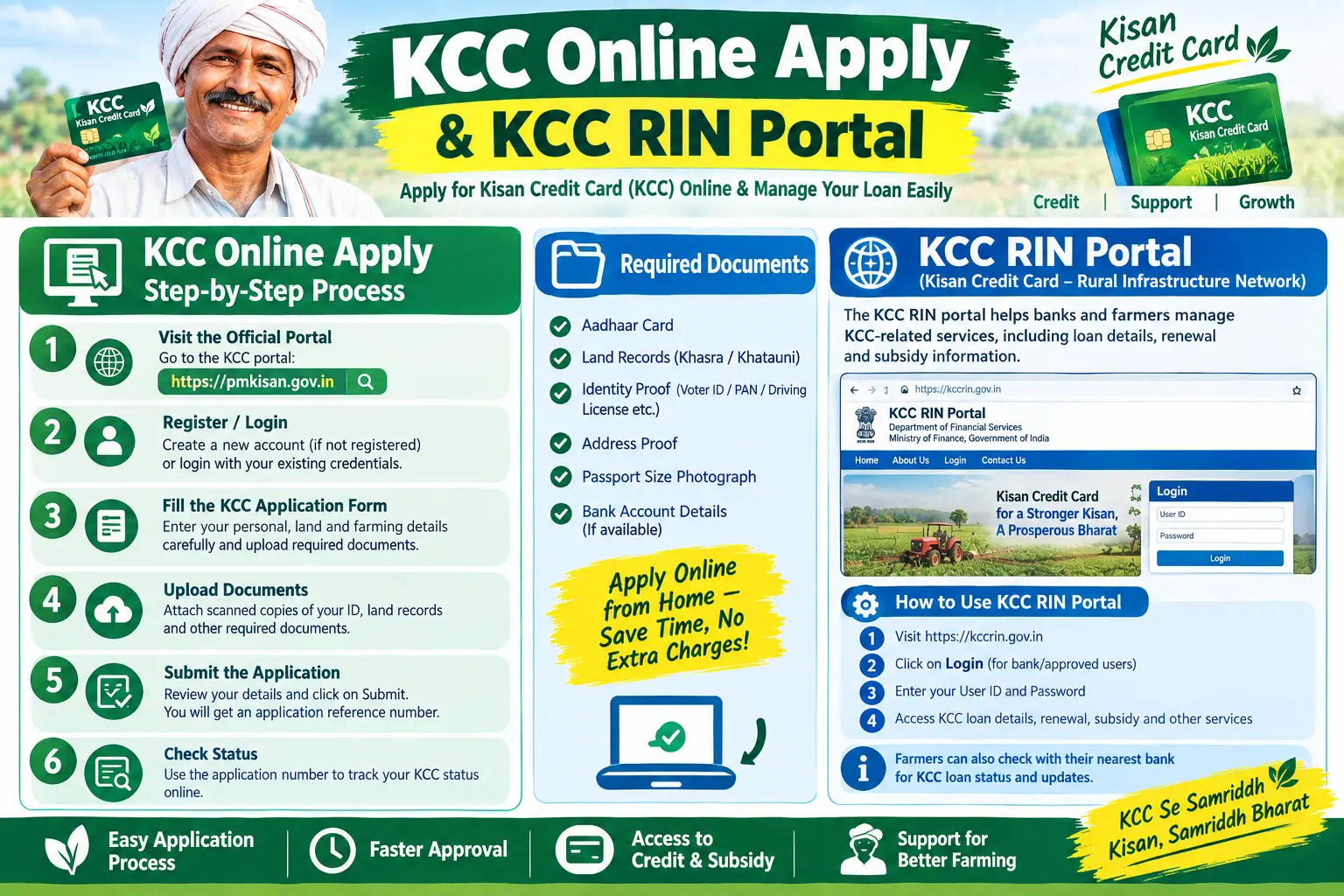
A farmer in Bihar checks his bank passbook the day before sowing season and finds the balance too low to buy seeds. He has heard about the Kisan Credit Card but assumes it means a branch visit, a queue, and a week of waiting. That assumption costs him the sowing window. The reality is that kcc online apply now happens through bank apps, a government single-window portal, and even a dedicated mobile app, often without stepping into a branch at all. This article covers the KCC scheme, the KCC Rin Portal, the actual application steps, and the mistakes that cause most rejections or delays.
The KCC has been around since 1998, but the digital layer on top of it is what has changed things for small farmers. Knowing which portal does what matters, because one of them is not an application portal at all.
What the Kisan Credit Card Actually Gives You
KCC is a revolving credit facility, not a one-time loan. Once sanctioned, you can draw funds as needed, repay, and draw again within the limit, which suits the cyclical nature of farming better than a fixed-term loan.
The scheme originally covered crop production only. It now extends to dairy, fisheries, poultry, and animal husbandry, so a farmer with two buffaloes and no cropland can still apply. The loan limit was raised from ₹3 lakh to ₹5 lakh in early 2025. Loans up to ₹2 lakh are generally available without collateral, which is the detail that matters most to small and marginal farmers who have no assets to pledge.
Interest works through a subvention structure. The base rate for short-term crop loans is typically 7% per annum, and farmers who repay on time receive a 3% prompt repayment incentive, bringing the effective cost to around 4%. Rates and subvention rules are revised from time to time, so confirm the current position with your bank rather than relying on any figure you read online.
Discover More About:👇
KCC – Kisan Credit Card Full Guide 2026
KCC Loan Kaise Milega – Interest Rate & Documents
The KCC Rin Portal Is Not Where You Apply
This is the most common misunderstanding. The KCC Rin Portal, also called the Kisan Rin Portal, was launched in September 2023, and farmers often assume it is the application gateway. It is not.
The Kisan Rin Portal is a monitoring and data integration platform. Banks report beneficiary data, loan disbursement details, and interest subvention claims into it, and government agencies use it to track scheme utilisation and release subvention funds. It exists to make sure credit and interest benefits reach eligible farmers without administrative leakage.
Your application may appear in the KCC Rin Portal system after your bank processes it, but you cannot walk into it and file a fresh KCC request. Use it to understand the scheme, not to apply.
How to Apply for KCC Online: Step by Step
The exact screens differ across platforms, but the sequence is consistent. Here is what the process actually looks like.
Step 1: Pick the right platform for your situation
You have four realistic options:
JanSamarth Portal — a single-window platform connecting government-backed loan schemes with a large network of lending institutions. Best if you want to compare banks or are not sure which bank to approach.
Your bank’s website or app — SBI via YONO, PNB via PNB ONE, and most other major banks have a KCC section. Best if you already hold a savings account with that bank, since your KYC and transaction history are already on file.
PM-Kisan Portal — if you already receive PM-Kisan instalments, there is a KCC link in the quick links section. Convenient, but your application still routes to a bank for sanction.
Krishika App — built specifically for KCC applications from a smartphone.
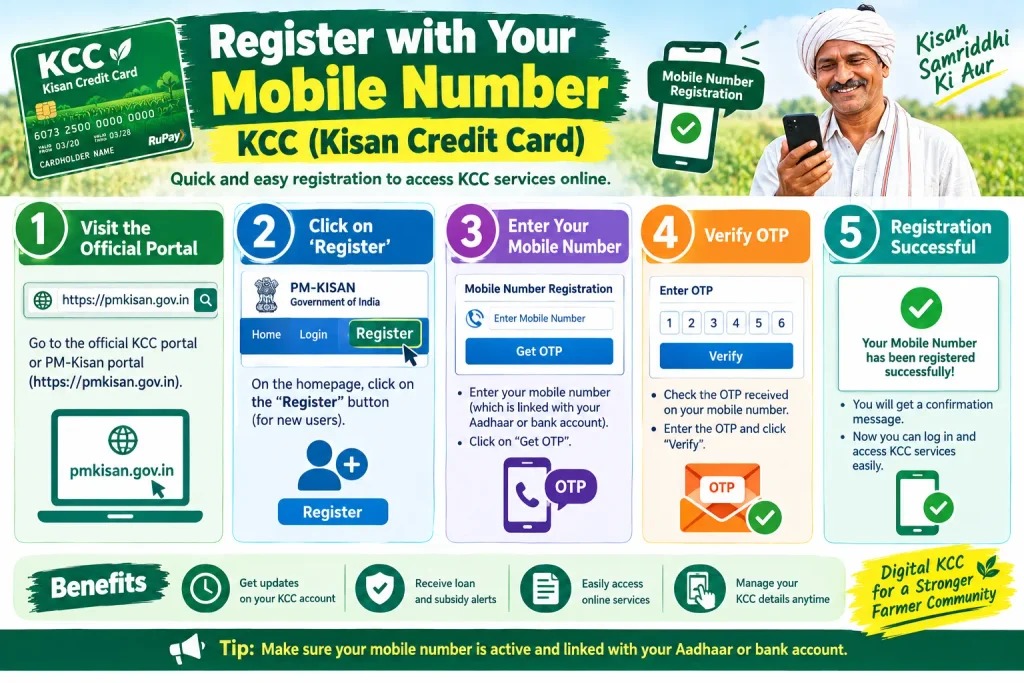
Step 2: Register with your mobile number
You will enter your mobile number, receive an OTP, and verify. Use the number linked to your Aadhaar and bank account. This is where many applications stall: if your mobile number is not registered with your bank, the OTP either does not arrive or the bank cannot match your record later.
Step 3: Fill in landholding and activity details
Expect to enter your land area, the crops you grow, and your bank account details. For allied activities, you will describe the activity, such as the number of animals or the size of the fishery. Enter figures that match your land records exactly. A one-acre mismatch between the form and the khatauni is enough to trigger a query.
Step 4: Upload documents
Scanned copies need to be readable. Phone photographs taken in poor light are a frequent cause of rejection, so scan or photograph in daylight against a plain background and check that text is legible before uploading.
Step 5: Submit and track
You will receive an application reference number. Keep it. Track status through the platform you used. Banks aim to respond within a few working days in many cases, but there is no guaranteed timeline, and branch workload affects it.
Two pitfalls worth knowing. First, portal sessions time out. If you take too long gathering a document mid-application, you may lose entered data. Keep scans ready in a folder before you start. Second, do not submit the same application twice through two different platforms. It creates duplicate entries at the bank and slows both down.
Who Is Eligible
Eligibility is broader than most farmers assume. It generally covers owner-cultivators, tenant farmers, oral lessees, and sharecroppers, as well as Self Help Groups and Joint Liability Groups of farmers. Farmers engaged only in allied activities such as dairy or fisheries also qualify.
The age range is typically 18 to 75 years. Applicants above 60 may be asked to add a co-borrower, which is a bank requirement rather than a scheme exclusion.
Discover More About:👇
Pashu Kisan Credit Card – Complete Guide
Documents to Keep Ready
Gather these before opening any portal:
- Identity proof — Aadhaar, PAN, voter ID, or driving licence
- Address proof — Aadhaar, ration card, or electricity bill
- Land documents — proof of landholding certified by revenue authorities, such as khatauni or khasra records
- Bank account details — savings or current account information
- Passport-sized photographs
- Crop or activity details — what you cultivate, or the nature of your allied activity
For loans above the collateral-free limit, the bank will ask for additional security documents as per its sanction terms.
Common Mistakes That Delay Applications
Mismatched details. Your name and address should read the same across Aadhaar, land records, and bank records. Even a spelling variation can trigger manual verification.
Unreadable uploads. Blurry or cropped scans get returned. This is the easiest mistake to avoid and one of the most frequent.
Applying through paid intermediaries. Only use government portals, official bank channels, and recognised apps. Any service charging a fee to “guarantee” approval is not legitimate.
Missing bank communication. Banks often request clarifications by SMS or email. If you do not respond, the file sits idle. Watch for messages after submission.
Treating submission as approval. Filing an application does not mean sanction. Eligibility is assessed on land records, credit history, and the bank’s internal criteria, and rejection is possible.
Frequently Asked Questions
Can I apply for KCC without land ownership documents?
Tenant farmers, sharecroppers, and oral lessees can apply, but they need documents proving cultivation rights rather than ownership. The accepted proof varies by bank and state, so confirm the requirement with your branch before applying.
Is the KCC Rin Portal the same as the application portal?
No. The KCC Rin Portal is a monitoring and data integration platform used by banks and government agencies to track disbursement and subvention claims. Submit new applications through the JanSamarth Portal, your bank’s website or app, or the Krishika app.
How long does KCC approval take?
There is no fixed timeline. Some banks respond within a few working days, but branch workload and the completeness of your application affect it. Track status using the reference number you received.
What is the maximum loan amount under KCC?
The limit was raised to ₹5 lakh in 2025. The amount actually sanctioned depends on your landholding, cropping pattern, and the bank’s assessment. Loans up to ₹2 lakh are generally available without collateral.
Can I apply if I am already a PM-Kisan beneficiary?
Yes. PM-Kisan beneficiaries can often apply through the PM-Kisan portal, but KCC eligibility is assessed separately against the scheme’s own criteria.
What interest rate applies to a KCC loan?
The base rate is typically 7% per annum for short-term crop loans, with a 3% prompt repayment incentive bringing the effective rate to around 4%. Rates and subvention rules change, so verify current figures with your bank.
If your application is rejected, ask the branch for the specific reason in writing rather than reapplying blindly. Most rejections trace back to a document mismatch or incomplete land record, both of which are fixable. And if your bank has not responded within two to three weeks of submission, follow up with your reference number at the branch directly. Applications rarely move on their own.
