


You have prepared the land records, filled the form, and submitted it at the bank. Then the waiting begins. Or worse — you applied online, the page timed out, and you are not sure whether the application went through. If any of this sounds familiar, the problem is rarely your eligibility. It is usually the paperwork and the follow-up.
Kisan Credit Card (KCC) is a government-backed credit scheme that gives farmers access to short-term loans for crop cultivation, post-harvest expenses, and allied activities like dairy and fisheries. If you are a farmer wondering how to get a KCC loan, this guide covers the eligibility rules, the actual interest rate structure, the documents you need, and the application process — both online and at the bank branch. The information here reflects current RBI and government scheme details, but rates and limits are revised periodically, so confirm the latest figures with your bank or on official RBI/NABARD notifications.
What Is Kisan Credit Card (KCC)?
KCC is not a credit card in the shopping sense. It works as a revolving credit limit — similar to an overdraft — that your bank sanctions based on your landholding, cropping pattern, and farm-related needs. You can withdraw money when you need it for seeds, fertiliser, pesticides, irrigation, or household consumption during the crop cycle, and repay after harvest. The limit is typically fixed for five years, with annual reviews.
The scheme was launched in 1998 by NABARD to reduce farmers’ dependence on private moneylenders and ensure they get institutional credit at concessional rates. As of early 2026, over 7.7 crore KCC accounts are active, with outstanding credit crossing ₹10.2 lakh crore .
Discover More About:👇
KCC – Kisan Credit Card Full Guide 2026
KCC Online Apply & KCC Rin Portal
KCC Loan Interest Rate – How Much Will You Actually Pay?
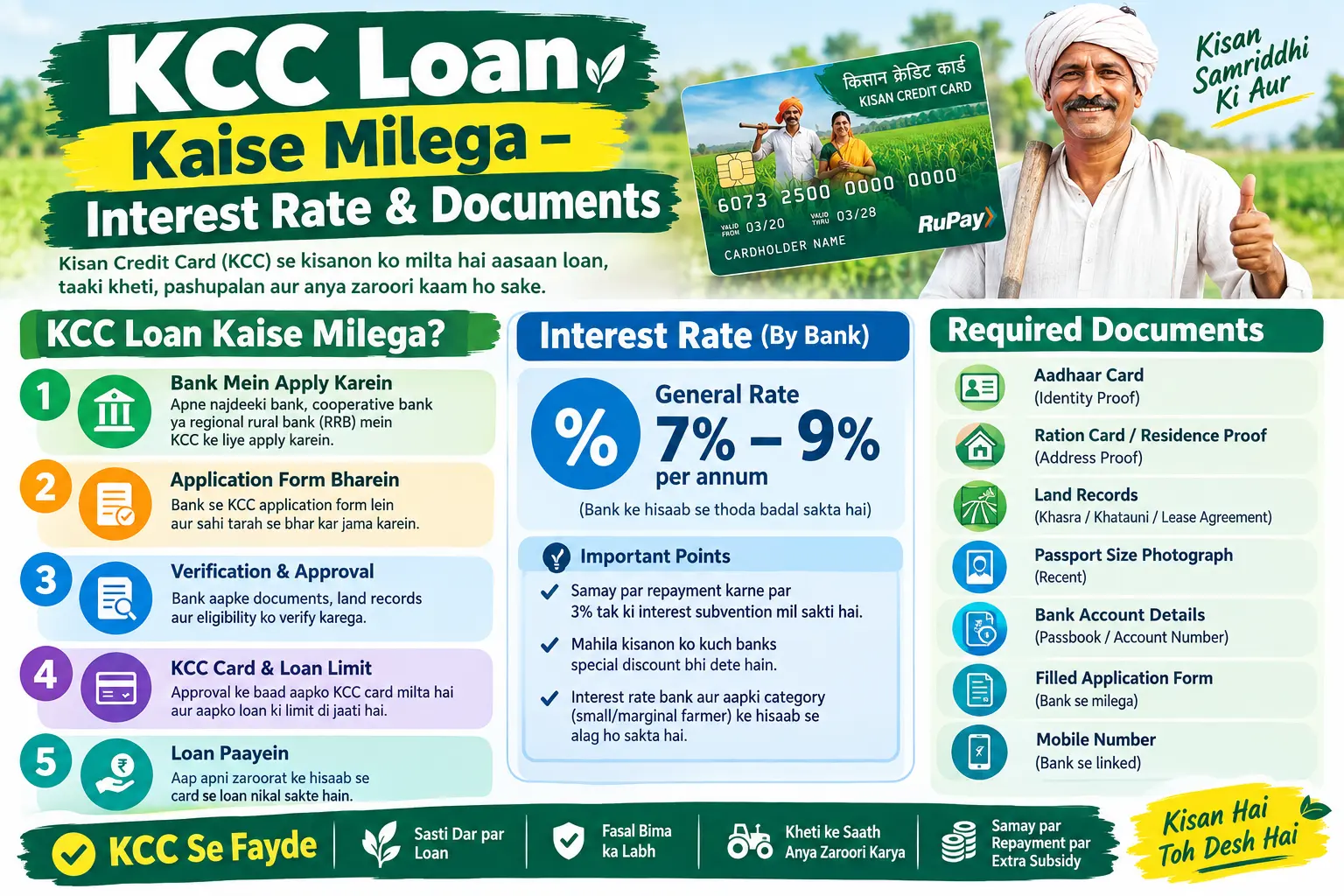
The headline interest rate on KCC short-term crop loans is 7% per annum for loans up to ₹3 lakh. But here is the part most farmers care about: if you repay on time, the effective rate drops to 4% per annum .
This works through two layers of benefits:
Interest Subvention of 1.5–2%: The Government of India provides a subsidy to banks on KCC loans up to ₹3 lakh, which reduces the rate from the bank’s base rate to 7% for the farmer. For FY 2025-26, the rate of interest subvention to lending institutions is 1.50% .
Prompt Repayment Incentive (PRI) of 3%: If you repay the loan within one year from disbursement (or by the due date fixed by the bank), you get an additional 3% concession. That brings your effective cost down to 4% per annum .
The critical condition: this 4% rate is not automatic. If you repay late — even by a few days beyond the due date — you lose the 3% prompt repayment incentive, and the rate goes back to 7%. The benefit does not accrue to farmers who repay after one year of availing the loan .
For loans beyond ₹3 lakh, the subvention benefit does not apply on the entire amount. The crop loan limit under the Modified Interest Subvention Scheme (MISS) has been raised to ₹5 lakh, but the concessional 7% rate with the 3% incentive applies to the portion up to ₹3 lakh. On the amount above ₹3 lakh and up to ₹5 lakh, your bank charges its own benchmark rate, capped at 10% as per the MISS extension for FY 2025-26. Check with your bank for the exact slab structure on higher limits .
KCC Loan Eligibility – Who Can Apply?
Not every farmer automatically qualifies. Here is who is generally eligible:
- Owner-cultivators – Individual farmers or joint borrowers who own and cultivate their land
- Tenant farmers, oral lessees, and sharecroppers – Even if you do not own the land, you can apply if you cultivate it
- Self Help Groups (SHGs) and Joint Liability Groups (JLGs) of farmers, including tenant farmers and sharecroppers
- Farmers involved in allied activities – Dairy, animal husbandry, fisheries, poultry, and similar activities are covered
- Age requirement – Generally between 18 and 75 years. Farmers above 60 may need a co-borrower who is a legal heir, depending on the bank’s policy
You will need proof of cultivation — land records, lease agreement, or a certificate from the revenue authority — to establish that you are genuinely engaged in farming. For allied activities like dairy or fisheries, the overall limit is ₹3 lakh, with a sub-limit of ₹2 lakh for farmers involved only in animal husbandry, dairy, or fisheries .
Documents Required for KCC Loan
The exact document list varies slightly from bank to bank, but the core set is fairly standard:
Identity Proof (any one): Aadhaar card, Voter ID, PAN card, Passport, or Driving Licence.
Address Proof (any one): Aadhaar card, Ration card, Electricity bill, Telephone bill, Lease agreement, or Passport.
Land and Cultivation Documents: Land records (Khasra/Khatauni or equivalent), land tax paid receipts, lease agreement if you are a tenant farmer, and cropping pattern details.
Photographs: Recent passport-size photographs.
Bank-related documents: Completed KCC application form, existing bank account passbook or statement (usually last six months), and any collateral documents if the loan limit exceeds the collateral-free threshold. Collateral-free credit is available up to ₹2 lakh per borrower, effective from 1 January 2025 .
If you are applying for a joint KCC or as part of an SHG/JLG, additional documents related to the group structure and members may be needed.
How to Apply for KCC Loan – Step-by-Step Process
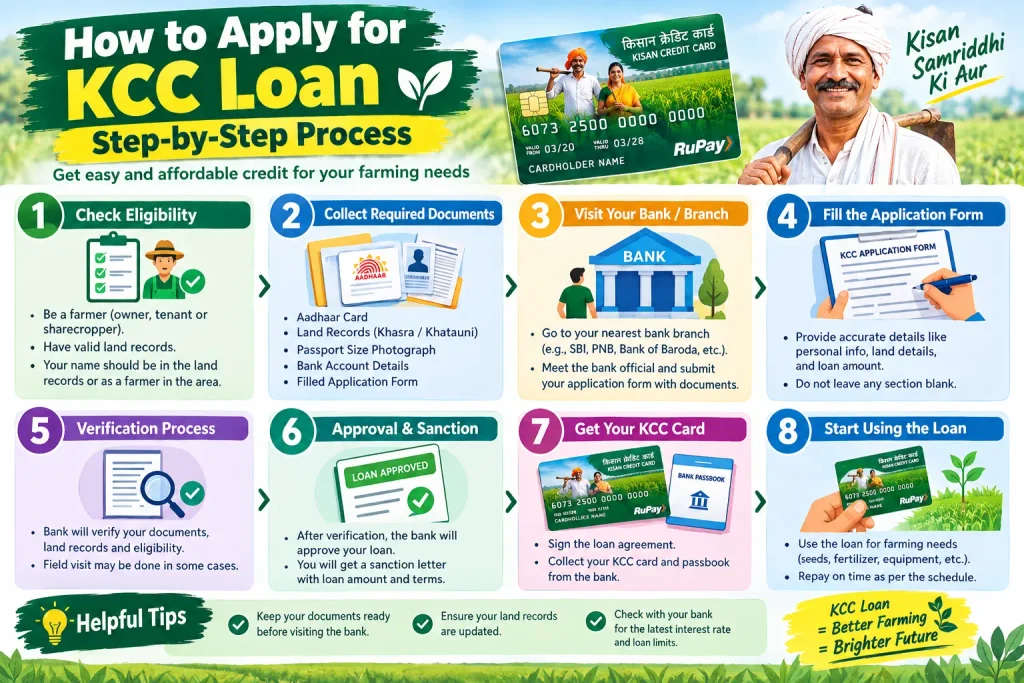
You can apply either offline at a bank branch or through online channels where your bank supports it. The e-KCC portal, developed by NABARD for Regional Rural Banks and Rural Cooperative Banks, has digitised the process for many applicants . Some states report disbursal within minutes through this system, though timelines vary by bank and application completeness .
Offline Process at Bank Branch
- Visit your nearest bank branch – This can be a public sector bank, regional rural bank, cooperative bank, small finance bank, or even some private banks that offer KCC.
- Ask for the KCC application form – The staff will provide you with the form and explain the basic requirements.
- Fill the form completely – Enter your personal details, landholding information, cropping pattern, and the loan amount you are seeking. Be accurate — discrepancies can delay processing.
- Attach all required documents – Use the document list above as a checklist.
- Submit the form – The bank will acknowledge receipt and may give you a reference number for tracking.
- Bank verification – A bank official, sometimes accompanied by an agriculture officer, may visit your farm to assess the land and crop. This is a standard step for KCC sanction.
- Sanction and card issuance – Once approved, the bank will fix your credit limit and issue the KCC. You can then withdraw funds as needed within the limit.
Discover More About:👇
Pashu Kisan Credit Card – Complete Guide
Online Application (Where Available)
Many banks now allow KCC applications through their net banking portals or mobile apps. The Jan Samarth portal has been started as a one-stop digital platform for linking government-sponsored loans and subsidies schemes including Kisan Credit Card . The general online steps are:
- Visit your bank’s official website, app, or the Jan Samarth portal.
- Look for the Kisan Credit Card section under agricultural or rural banking services.
- Fill the online application form with your personal, land, and cultivation details.
- Upload scanned copies of the required documents.
- Submit and note the application reference number.
- The bank will contact you for verification or further steps if needed.
Common pitfalls to watch for: The portal may time out if you leave the form idle for too long — keep your documents scanned and ready before starting. If the page freezes after submission, do not refresh immediately. Check whether you received a reference number via SMS or email. If not, wait a few hours before attempting again, or call the bank’s helpline. Applying twice in quick succession can create duplicate entries that slow down processing.
Some banks also offer KCC application tracking through their portals or through the Common Service Centre (CSC) network if you applied through a CSC.
Common Mistakes to Avoid
Late repayment: The 3% prompt repayment incentive is lost if you repay even one day after the due date. Set a reminder or arrange repayment as soon as you sell your harvest.
Incomplete land documents: If your land records are unclear, disputed, or not updated, the bank may reject or delay your application. Get a certified copy from the revenue office.
Not checking the limit calculation: Your KCC limit is not a fixed amount for everyone. It depends on your land size, crop type, and the scale of finance for your district. Ask the bank to explain how they arrived at your limit.
Assuming loan waiver applies: Farm loan waivers are state-specific and based on eligibility criteria that change. There is no central scheme that automatically waives all KCC loans. The Finance Minister stated in March 2026 that there is no proposal under consideration for a full-fledged nationwide farm loan waiver . Always check your state government’s official notifications before assuming any waiver applies to you.
Ignoring insurance linkage: KCC loans are typically linked to crop insurance under PMFBY. Make sure you understand the premium deduction and coverage.
FAQs
Can I get a KCC loan without land ownership?
Yes, tenant farmers, oral lessees, and sharecroppers can apply. You will need a lease agreement or a certificate from the revenue authority confirming your cultivation rights.
What is the maximum KCC loan amount I can get?
The crop loan limit under the Modified Interest Subvention Scheme has been raised to ₹5 lakh. However, the concessional 7% rate with the 3% prompt repayment incentive applies to the portion up to ₹3 lakh. The actual amount depends on your landholding, cropping pattern, and the bank’s assessment. For allied activities like dairy or fisheries, the overall limit is ₹3 lakh with a sub-limit of ₹2 lakh for farmers involved only in those activities .
Is collateral required for KCC?
For loans up to ₹2 lakh per borrower, collateral security is generally not required, effective from 1 January 2025 . For higher limits, the bank may ask for collateral or other security as per its credit policy.
What happens if I repay my KCC loan late?
You lose the 3% prompt repayment incentive, so your effective interest rate goes back to 7% per annum. Persistent default can affect your credit history and future borrowing ability.
Can I use KCC for dairy or fisheries?
Yes, KCC covers short-term credit for allied activities including animal husbandry, dairy, and fisheries. The overall limit is ₹3 lakh, with a sub-limit of ₹2 lakh for farmers involved only in these activities .
How do I check my KCC application status?
If you applied through a bank’s online portal or the Jan Samarth portal, you can usually track it there. For applications through CSC, you can check the PM KCC portal with your application ID. Otherwise, visit your bank branch with your reference number.
A Final Note
KCC is one of the most practical credit tools available to Indian farmers, but it works best when used responsibly and repaid on time. The 4% effective rate is a real benefit — but it is conditional, not guaranteed. Before applying, gather your land documents, talk to your bank about the limit calculation, and understand the repayment schedule for your crop cycle. If your application is rejected or delayed without clear reason, ask for the specific deficiency in writing — that written response is often what moves the file forward. For the latest interest rates, subvention rules, and scheme updates, refer to the official RBI notifications and NABARD guidelines, or ask your bank’s agricultural officer for current details.

2 Comments
Pingback: KCC – Kisan Credit Card Full Guide 2026
Pingback: Pashu Kisan Credit Card – Complete Guide